












Tracked Political Victimization Incidents Since 2023
Aside from the targeted harassment of high-profile individuals, several opposition parties have reported institutional and physical victimization:
- Arson Attacks: The African Democratic Congress (ADC) experienced the torching of its Ekiti State secretariat by suspected political thugs. The party claimed this was a calculated effort to terrorize the opposition ahead of scheduled electoral contests.
- Judicial Overreach Accusations: Both the Obidient Movement and the PDP have alleged that the ruling establishment has “weaponised the judiciary” to undermine credible challengers, arbitrarily deregister opposing platforms, and impose candidates ahead of subsequent national elections.
- Media Gagging: Reports from independent human rights groups indicate that dozens of journalists have faced arrests and detentions by state security agencies (such as the DSS and Police) for covering dissenting political views and protests.
For a detailed, ongoing breakdown of political violence and incidents, you can review the ACLED Conflict Index. You can also monitor human rights violations and civic space crackdowns through the Amnesty International Nigeria portal.
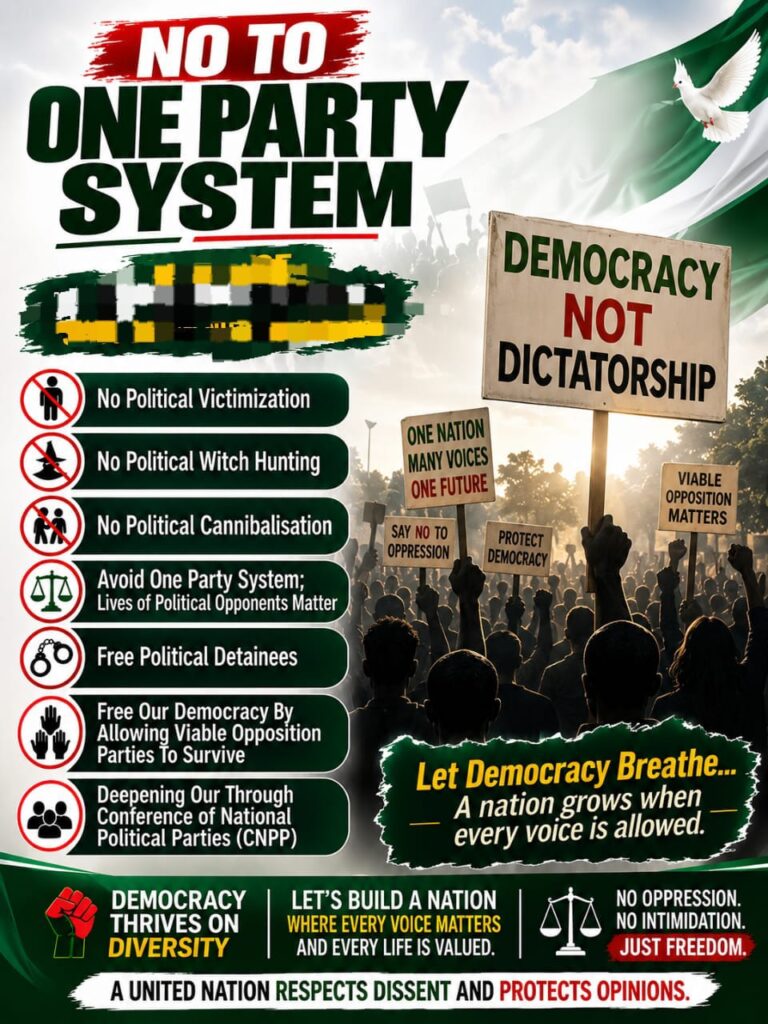
Since the 2023 elections, Nigeria has witnessed a continuous wave of defections and legal battles that have left major opposition platforms severely weakened, resulting in widespread political dominance by the All Progressives Congress (APC). This consolidation has sparked intense national debates regarding its democratic impact.
Consequences of One-Party Dominance and Opposition Weakening
| Consequence Area | Explanation & Mechanism |
| Erosion of Checks & Balances | With the APC holding overwhelming majorities in the National Assembly (controlling over 250 House of Representatives and nearly 90 Senate seats) and sweeping 32 of 36 state governorships, there is limited legislative pushback against executive actions. |
| Suppression of Dissent | Civil society and political analysts highlight that a dominant party system often leads to the harassment or silencing of dissenting voices and critical media. |
| Stifled Public Debate | The near-absence of a vibrant opposition stifles healthy public debate, leaving alternative policy perspectives marginalized or entirely ignored in governance. |
| Opportunistic Defections | Politicians from opposition parties like the Peoples Democratic Party (PDP) and Labour Party (LP) frequently defect to the APC, often seeking “alignment with the center” or protection against statutory investigations. |
| Weaponization of Institutions | Opposition figures have frequently alleged that state powers and the judiciary are being utilized to politically victimize opponents, leading to deeply contested court rulings. |
| Public Apathy | The lack of a clear, competitive alternative leads to voter disillusionment, ultimately resulting in lower voter turnout and disengagement from the democratic process. |
| Complacency & Governance Risks | Without the constant pressure of a viable opposition, ruling parties may become complacent, potentially increasing the risk of corruption and administrative impunity. |
Perspectives on the Political Climate
The debate regarding this shift in Nigeria’s political landscape is highly polarized:
- Opposition & Civil Society View: Opposition groups, such as the Obidient Movement and the African Democratic Congress (ADC), argue that the APC is deliberately weakening rival parties to establish a one-party state. Critics warn that this poses a threat to multi-party democracy, human rights, and political pluralism.
- Ruling Party View: The APC and the Presidency maintain that the opposition’s struggles are self-inflicted. They argue that opposition parties lack ideology, fail to meet Independent National Electoral Commission (INEC) administrative deadlines, and only resort to baseless victimization claims to cover for internal disarray.